


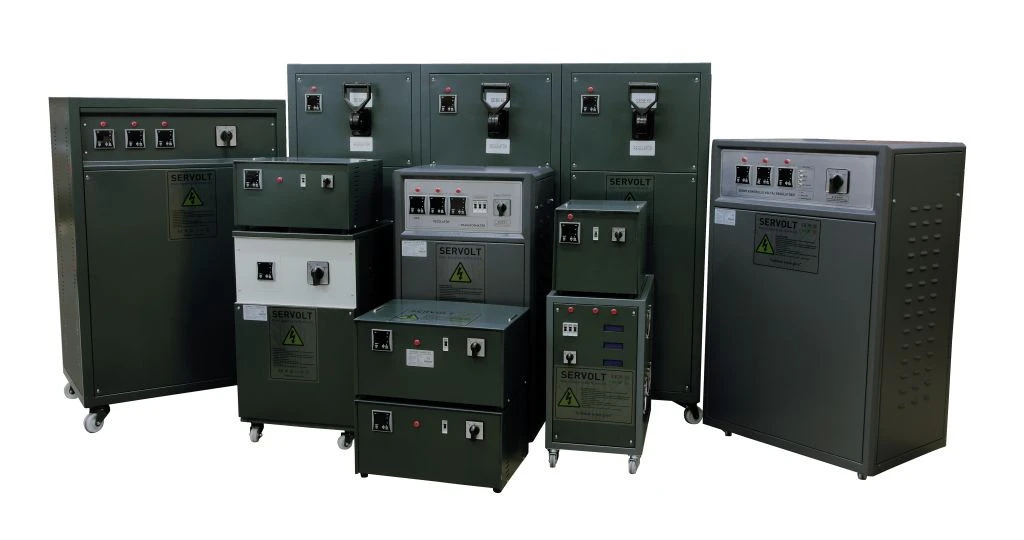
Unstable voltage from the utility grid or a generator can damage equipment, interrupt production, and increase maintenance costs. These problems do not always appear as sudden failures. They may develop gradually, causing motors to overheat, electrical insulation to deteriorate prematurely, and electronic control systems to reset unexpectedly.
A properly selected voltage stabilizer helps compensate for supply fluctuations and supports reliable equipment operation. To achieve the desired results, its capacity, input voltage range, and regulation characteristics must match the facility’s actual operating conditions.
For industrial facilities, it is important to understand how voltage fluctuations affect equipment, how three-phase stabilizers operate, when independent phase regulation is necessary, and how voltage stability can be improved in generator-powered systems.
Why Do Voltage Fluctuations Damage Industrial Equipment?
Three-phase electric motors are particularly sensitive to voltage imbalance between phases. Even a small difference in phase voltages can create a much larger imbalance in the currents flowing through the motor windings.
This condition can cause excessive heat to develop in individual windings. Higher temperatures accelerate electrical insulation deterioration and may shorten equipment service life. An increase of approximately 10°C in operating temperature can roughly halve the expected life of electrical insulation.
Undervoltage can make it difficult for electric motors to start, prevent them from delivering the required power, or cause them to stall under load. Overvoltage can increase magnetizing current and heat generation, negatively affecting motor performance.
Voltage imbalance and recurring voltage dips or surges can also affect control panels, electronic devices, and other electrical equipment. Monitoring power quality and selecting suitable protective equipment are therefore important for industrial facilities.
How Does a Voltage Stabilizer Work?
A voltage stabilizer is an electrical device designed to detect input voltage variations and maintain its output as close as possible to the nominal level. Many stabilizers achieve this by adjusting the output taps of an autotransformer.
The control system continuously measures voltage and compares it with a predefined reference value. When a deviation is detected, the system adjusts the appropriate transformer tap to regulate the output. Depending on the design, this process may be controlled by a servo motor or a digital control system.
When correctly selected, modern stabilizers can operate efficiently while minimizing the effect on the electrical waveform. Some models also include overvoltage and undervoltage protection that disconnects the load when the input moves outside the permitted operating range.
In simple terms, a stabilizer measures voltage, detects deviations, and adjusts the output. Its actual performance depends on the model’s specifications and operating conditions.
Three-Phase Regulation: Unified and Independent Phase Control
Three-phase voltage stabilizers differ in how they regulate the individual phases. The selection process should take into account the level of phase balance within the facility’s electrical system.
Unified regulation controls all three phases through a common regulation mechanism. This approach can be simpler and more economical. It is generally suitable for systems where there is no significant voltage imbalance between phases.
Independent phase regulation measures and corrects each phase separately. It can be more suitable when phase imbalance is significant, single-phase loads are unevenly distributed, or generator loads change frequently.
Independent regulation is not necessary in every installation. The appropriate configuration depends on the electrical system design, load characteristics, and equipment requirements.
Why Might Generator Systems Need Additional Voltage Stabilization?
Generators provide primary or backup electrical power, but their presence does not guarantee perfectly stable voltage.
Starting a large electric motor, connecting several devices simultaneously, or changing the load suddenly can cause generator output voltage to dip or rise. These fluctuations may affect sensitive electronic equipment and automatic control systems.
In generator-powered facilities, a voltage stabilizer may be installed as part of the electrical distribution system, in a suitable position relative to the generator, automatic transfer switch (ATS), and distribution boards supplying sensitive equipment.
A stabilizer is designed to compensate for voltage fluctuations within its operating range. Separate protective devices, including circuit breakers and protective relays, are still required to address short circuits, excessive currents, and other electrical faults.
Generator systems may also experience uneven loading across the three phases. For this reason, stabilizers with independent phase regulation can be a suitable option for certain industrial facilities, hospitals, hotels, and other sites that depend on reliable power.
What Should You Consider When Selecting a Three-Phase Voltage Stabilizer?
Selecting a stabilizer for an industrial facility requires more than checking its rated capacity. Supply characteristics, load variations, operating conditions, and protection requirements must all be evaluated.
Capacity (kVA). The stabilizer must be appropriately sized for the total connected load. Motor starting currents and other short-term load increases should also be considered.
Input voltage range. This determines how much voltage variation the stabilizer can compensate for. If the input voltage exceeds the permitted range, the protection system may disconnect the load.
Output voltage accuracy. This indicates how closely the stabilizer maintains its output around the nominal value. It is particularly important for sensitive electronic devices and industrial control systems.
Thermal rating and insulation. The equipment must be suitable for continuous industrial operation. Ambient temperature and cooling requirements should also be considered.
Protection functions. Check for protection against overvoltage, undervoltage, overload, short circuits, and phase loss. These functions should be coordinated with the facility’s overall electrical protection system.
Five Signs Your Facility May Need a Three-Phase Voltage Stabilizer
Identifying electrical supply problems early can help protect equipment and reduce unexpected downtime. The following signs may indicate that the electrical system needs to be assessed.
Motors and transformers overheat. Possible causes include phase voltage imbalance and other electrical supply problems.
Electronic equipment resets unexpectedly. This may occur during generator startup or when utility voltage drops.
Voltage differs between phases. Measurements may reveal that one phase consistently has a higher or lower voltage than the others.
Electric motors fail prematurely. Frequent repairs or rewinding without an obvious mechanical cause may indicate a need to investigate the electrical supply.
The facility uses long generator cables or a weak electrical feeder. Long cable runs can cause voltage drops, while unevenly distributed single-phase loads can increase phase imbalance.
If any of these signs appear, measure phase voltages under representative operating conditions before deciding whether a stabilizer is the appropriate solution. Identifying the underlying cause is essential to selecting suitable equipment.
Conclusion
Voltage stability is important for reliable industrial operation, longer equipment service life, and lower maintenance costs. The appropriate stabilizer depends on the facility’s electrical supply characteristics, phase load distribution, and generator operating conditions.
Unified regulation may be sufficient for systems with reasonably balanced phase voltages. Independent phase regulation may be more suitable for facilities with uneven loads, weak electrical feeders, or generator-powered systems.
To select the right stabilizer, evaluate the total load, motor starting currents, input voltage range, required output accuracy, and protection functions. A professional assessment of the electrical system helps identify the appropriate equipment, improve supply reliability, and reduce the risk of technical failures.
 Fill in the required fields and you will be contacted soon