


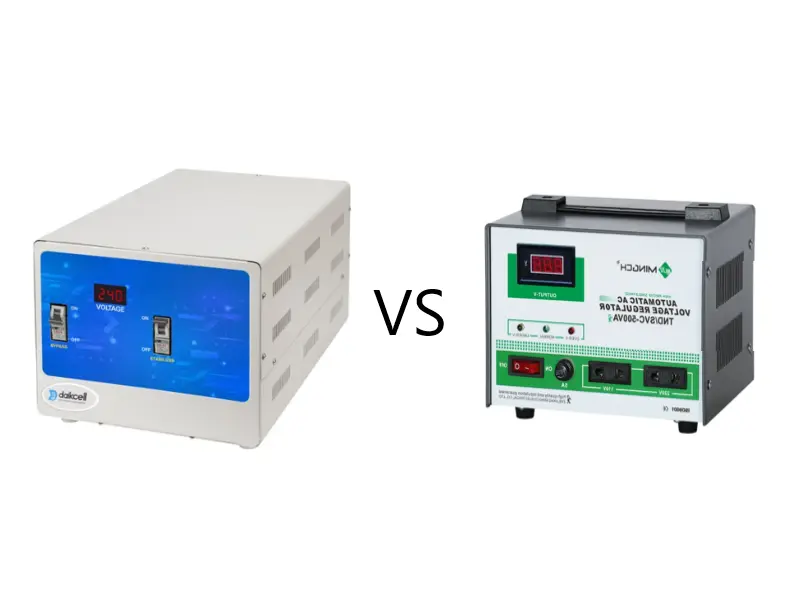
In modern conditions, voltage stabilizers are considered one of the essential types of electrical equipment. Power networks often experience failures, and the supplied voltage parameters can vary within a wide range. Therefore, users face an important question: how can equipment be protected from voltage fluctuations?
The simplest solution is to use special equipment – a voltage stabilizer. The device is connected to the electrical network, constantly monitors voltage parameters, and provides stable output voltage with the required accuracy.
There are many types of stabilizers available on the market. However, in the low and medium price range, two main options are widely used: relay and servo voltage stabilizers.
Which stabilizer is better – relay or servo? Each option has its own advantages and disadvantages. When choosing the right model, it is necessary to consider the power of the connected equipment, the application area, and the required stabilization accuracy.
Relay or Servo Stabilizer – Which Is Better?
Relay stabilizers have a high efficiency rate and are among the most affordable models on the market. Although their design is based on older technology, they are still widely used by consumers.
Servo stabilizers provide more accurate voltage regulation. Their price is slightly higher, but they are more suitable for sensitive electronic equipment. At the same time, these devices require more maintenance and may produce some operating noise.
Relay Stabilizer Design
The main components of a relay stabilizer include:
- a transformer unit with 4 to 9 windings;
- a relay mechanism for switching between windings;
- a control unit that measures input current and regulates output voltage.
The relay system operates by switching between windings, which means the output voltage changes in steps. For example, in four-winding stabilizers, the adjustment step can be around 20 volts. The more windings there are, the higher the adjustment accuracy becomes, but the response time may change.
When the input voltage drops below the operating range of the stabilizer, the device may automatically switch off. Once the voltage returns to normal levels, the stabilizer starts operating again.
Advantages of Relay Stabilizers:
- operation within a wide input voltage range;
- resistance to changes in network parameters;
- ability to withstand short-term overloads;
- operation at temperatures from -40°C to +50°C;
- affordable price and long service life.
Disadvantages of Relay Stabilizers:
- step-by-step voltage regulation;
- lower accuracy in some cases;
- noise during frequent voltage fluctuations.
Nevertheless, relay stabilizers can be an effective choice for users who want to protect household appliances.
Servo Stabilizer – Advantages and Disadvantages
Servo stabilizers have a more advanced design and include:
- an electric motor;
- a control board.
The control unit provides smooth adjustment of output voltage. Electromechanical servo stabilizers offer high accuracy and are suitable for equipment sensitive to voltage fluctuations.
Although these models are slightly more expensive than relay stabilizers, they provide more accurate regulation and faster response. Servo stabilizers respond to voltage changes in approximately 8 milliseconds, while relay models respond in about 40 milliseconds on average.
Disadvantages of Servo Stabilizers:
- need for regular maintenance;
- wear of graphite contact brushes and the need for replacement;
- larger dimensions;
- operating noise.
As a result, relay stabilizers are a more suitable option for affordable and general use, while servo stabilizers are better suited for equipment requiring high stabilization accuracy.
 Fill in the required fields and you will be contacted soon